Northwest Florida's combination of sandy soils, intense seasonal rainfall, and hurricane-season storms makes erosion one of the most common and most damaging property problems across the region. Whether you are losing soil along a slope, watching your yard wash toward a neighbor's property, or seeing the base of a retaining wall expose itself after every heavy rain, erosion does not pause between storms. It accelerates. Every rainfall event moves more material, cuts deeper channels, and undermines more of the structures and landscaping you have invested in.
This guide covers the primary causes of erosion on Pensacola, Destin, Navarre, and Gulf Coast properties, the solutions that work in our specific soil and climate conditions, and how to determine which approach is right for your situation.
Why Erosion Is Worse in Northwest Florida
Erosion happens everywhere, but three factors make it more aggressive and more damaging along the Gulf Coast than in most other regions.
Sandy Soils With Low Cohesion
The soils across Escambia, Santa Rosa, Okaloosa, and Walton counties are predominantly sandy — often 80-95% sand content. Sandy soil has very low cohesion, meaning the particles do not bond to each other the way clay or loam soils do. When water flows across the surface, it picks up sand particles easily and transports them downhill. The same storm that would barely disturb a clay lawn in the Midwest can move hundreds of pounds of sand on a sloped Florida property in a single event.
Intense Rainfall Events
Pensacola averages over 65 inches of rain per year — nearly double the national average. But the distribution matters more than the total. Gulf Coast rainfall tends to arrive in intense bursts rather than gentle soaking rains. A typical summer thunderstorm can dump 2-3 inches in less than an hour. These high-intensity events overwhelm the soil's ability to absorb water, creating surface runoff that generates the erosive force responsible for gullying, sheet erosion, and slope failure.
Hurricane and Tropical Storm Impacts
The Gulf Coast sits in one of the most hurricane-prone corridors in the United States. Tropical systems bring sustained rainfall of 6-12 inches or more over 24-48 hours, combined with wind that strips vegetation and exposes bare soil. A single hurricane can undo years of erosion control work if the systems in place were not designed for storm-level events. Any erosion solution implemented on a Northwest Florida property must account for extreme rainfall, not just average conditions.
Types of Erosion on Gulf Coast Properties
Sheet Erosion
Sheet erosion removes a thin, uniform layer of topsoil across a broad area. It is the most common type on gently sloped properties and the hardest to notice because it does not create visible channels or gullies. The signs are subtle: grass that seems thinner each year, tree roots becoming more exposed, soil level dropping relative to sidewalks or foundations. Over several years, sheet erosion can remove inches of topsoil across an entire yard, reducing the growing capacity of the soil and exposing the sterile sand layer beneath.
Rill and Gully Erosion
When water concentrates into defined flow paths, it cuts rills (small channels) and gullies (larger channels) into the soil surface. This type of erosion is visually obvious and progresses rapidly. A small rill from one storm becomes a deeper channel in the next, which captures more water, which cuts deeper. On sandy Florida soils, gullies can deepen by several inches with each heavy rain event. Left untreated, they eventually reach a depth and width that makes them structural hazards.
Slope Failure
Slopes that become saturated during heavy rainfall can fail catastrophically — the soil mass slides downhill as a unit, taking vegetation, mulch, and anything anchored to it. This is common on steeper grades, along waterfront properties, and on bluffs overlooking the bay or sound. Slope failures are the most expensive erosion events to repair because they require not just re-establishing the grade but also stabilizing the slope to prevent recurrence.
Proven Erosion Control Solutions for Northwest Florida
Proper Grading and Drainage
The first line of defense against erosion is controlling where water flows across your property. Proper grading ensures that surface water is directed away from structures, slopes, and sensitive areas toward designated collection points or natural drainage channels. On flat or nearly flat properties (common in Gulf Breeze, Navarre, and Pace), even subtle grade adjustments of 1-2 inches over 10 feet can redirect water flow and eliminate pooling that saturates the soil and initiates erosion.
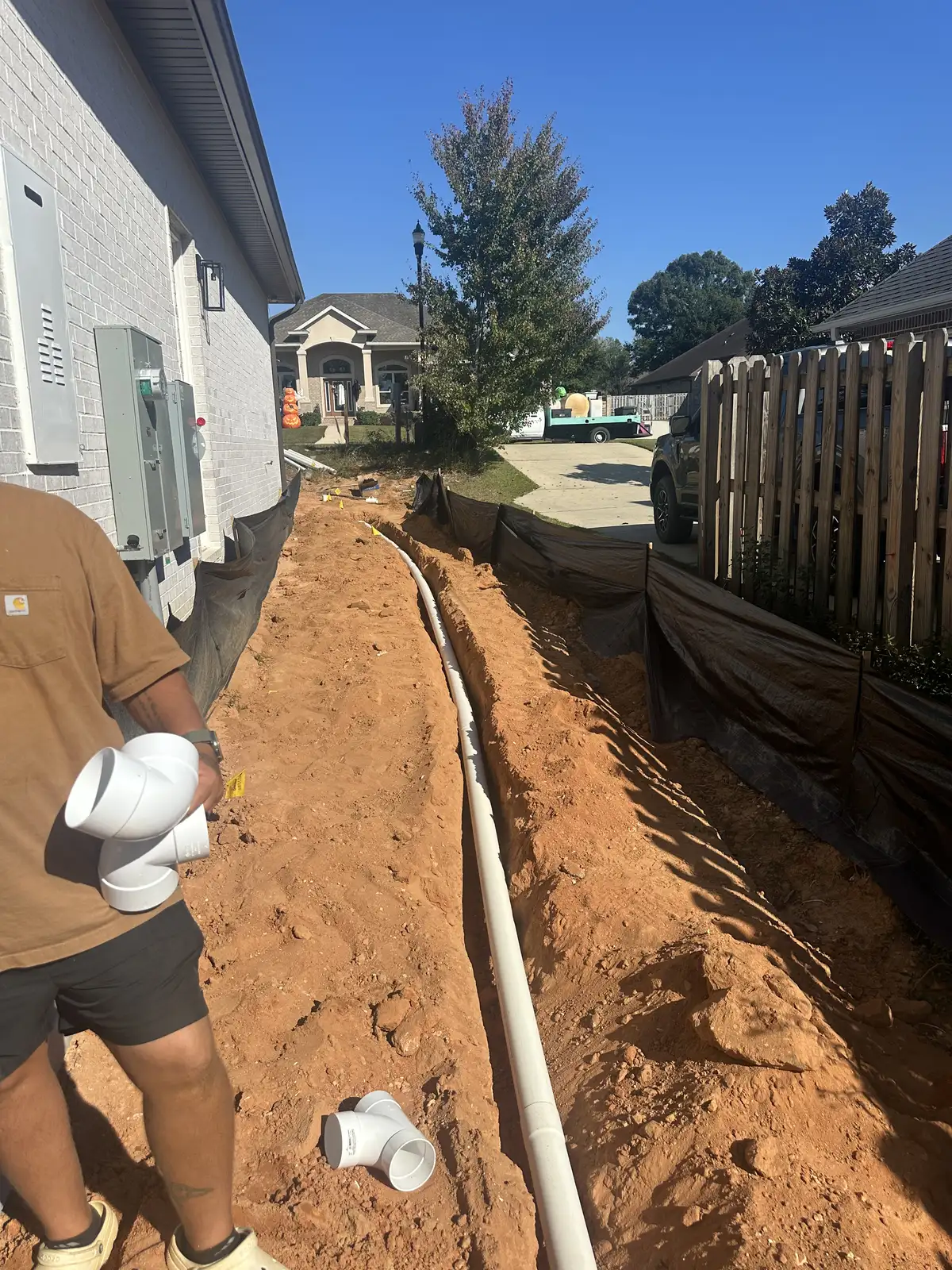
French drains, catch basins, and channel drains collect concentrated water and route it underground to a discharge point. These systems are particularly effective at intercepting water flowing down slopes before it gains enough velocity to cause erosive damage. On larger properties, swales — shallow, vegetated channels — provide natural drainage paths that slow water and allow sediment to settle before the water reaches the property boundary.
Sod Installation for Ground Cover
Bare soil erodes. Vegetated soil resists erosion. The simplest and most effective erosion control measure for large flat areas is establishing a healthy turf cover. Sod installation provides immediate ground cover — unlike seeding, which leaves soil exposed for weeks during germination. In Northwest Florida, we primarily use Zoysia and St. Augustine varieties because their root systems create a dense mat that holds sandy soil in place even during heavy rain events.
For areas where turf grass cannot establish (deep shade under tree canopy, steep slopes, persistently wet areas), ground cover plants like mondo grass, asiatic jasmine, or native shore juniper provide similar erosion resistance with lower maintenance requirements. The key is eliminating bare soil. Any exposed sand on a Florida property is erosion waiting to happen.
Retaining Walls for Slope Stabilization
Retaining walls are the definitive solution for slopes that are too steep or too long to stabilize with vegetation alone. A properly engineered retaining wall holds the uphill soil in place, prevents the downhill movement of the slope mass, and creates a terraced effect that breaks long slopes into shorter, more stable segments.
For erosion control applications in Northwest Florida, segmental retaining wall blocks (like Belgard or Pavestone products) with a geogrid-reinforced backfill provide both structural stability and excellent drainage. The open-face design of segmental blocks allows water to weep through the wall face rather than building up hydrostatic pressure behind it — a critical detail in a region where saturated backfill from heavy rain is the primary cause of wall failure.
For waterfront properties and areas with direct water exposure, riprap (large natural stone), gabion baskets, or concrete revetments may be more appropriate. The choice depends on the severity of water flow, the height of the grade change, and local permitting requirements.
Erosion Control Blankets and Matting
Erosion control blankets (ECBs) are temporary or permanent fiber mats that protect bare soil while vegetation establishes. They are particularly useful on slopes after grading, on newly sodded or seeded areas that are vulnerable to rain before roots anchor, and on construction sites where soil disturbance has created erosion risk.
In our applications across the Pensacola area, we use biodegradable coconut fiber blankets for temporary protection (they decompose over 12-24 months as vegetation fills in) and permanent turf reinforcement mats (TRMs) for slopes where long-term structural support is needed. TRMs stay in place permanently, hidden within the root zone of the established vegetation, providing ongoing reinforcement against concentrated water flow.
Mulch and Ground Cover for Landscape Beds
Landscape beds without adequate mulch cover are major erosion contributors on residential properties. A 3-4 inch layer of hardwood mulch or pine straw over landscape beds absorbs rainfall impact, slows surface runoff, and retains soil moisture that keeps plant roots healthy. On sloped beds, we recommend pine straw over hardwood mulch because the interlocking needles resist washing off the slope — a common complaint with bark mulch on Florida properties after heavy rain.
Hardscape Borders and Paver Edges
Strategic hardscaping serves double duty as both aesthetic improvement and erosion barrier. Paver patios, walkways, and driveway borders create impermeable boundaries that redirect water flow and prevent lateral soil migration. A paver border along the downhill edge of a landscape bed captures soil that would otherwise wash onto the lawn or sidewalk. These installations are particularly effective when combined with a drainage solution behind the paver edge to handle the redirected water.
When to Call a Professional
Minor erosion — small bare patches after a storm, light soil movement from a garden bed — can often be addressed with DIY measures like adding mulch, installing a splash block under a downspout, or establishing ground cover. But certain situations require professional assessment and engineered solutions:
- Erosion threatening a structure: If soil is moving away from your home's foundation, a retaining wall, or a driveway, the structural risk demands professional intervention before the next storm.
- Recurring gullies: If the same gully reappears after every rain despite your attempts to fill it, the underlying drainage pattern needs to be redirected, not just patched.
- Slope failure or sliding: Any visible slope movement — slumping turf, leaning trees, soil that has slid downhill — indicates a stability problem that will worsen without proper engineering.
- Waterfront erosion: Shoreline and bluff erosion along Pensacola Bay, Santa Rosa Sound, or the bayou system often requires permits and engineered solutions that comply with local and state environmental regulations.
- Water flowing onto neighboring properties: Erosion that directs water or sediment onto a neighbor's land creates legal liability. Resolving it professionally protects both the property and the relationship.
Protect Your Property Before Hurricane Season
Late May through June is the optimal window for erosion control work in Northwest Florida. The ground is workable, sod and vegetation have the full growing season ahead to establish, and — critically — the work is completed before the peak of hurricane season in August and September. Erosion problems that are manageable in May can become catastrophic failures during a tropical storm in September if left unaddressed.
Our team designs and installs complete erosion control systems across Pensacola, Destin, Navarre, Fort Walton Beach, Gulf Breeze, Santa Rosa Beach, 30A, and all of Northwest Florida and the Gulf Coast. From simple grading and sod work to engineered retaining wall systems and drainage networks, we match the solution to the specific soil, slope, and water conditions on your property.
Request a free estimate or call (850) 791-2199 to schedule a site assessment before the summer storm season arrives.